
Umar bin Abdul Aziz: the two-and-a-half-year caliphate remembered for centuries
Umar II ruled the Umayyad caliphate from September 717 to February 720, and historians note his changes to taxation, provincial rule and military policy.
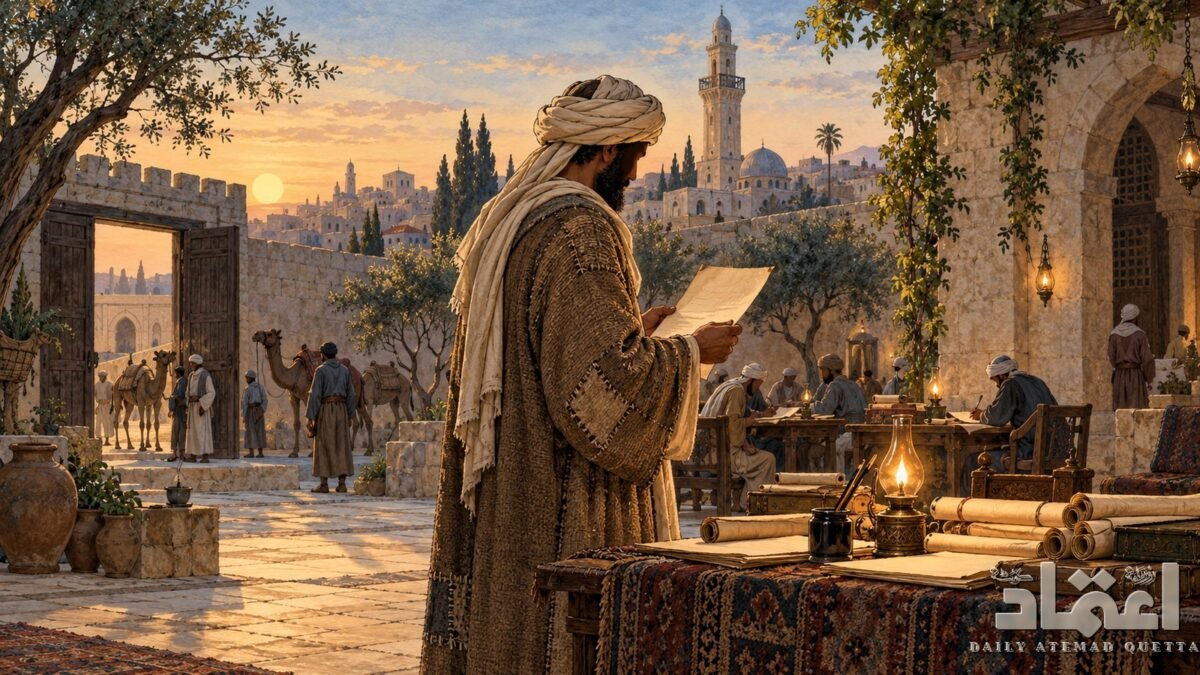
At the start of the eighth century, the capital of the Umayyad caliphate was Damascus, and its borders stretched from Spain to Sindh. The eighth caliph of the dynasty was Umar bin Abdul Aziz (Umar II). He ruled from September 717 to February 720, a period of less than two and a half years. Historians give him a distinct place among the Umayyad rulers because of the changes he made in taxation, provincial administration and military policy during this short reign.
Early life
According to the German historian Julius Wellhausen, Umar bin Abdul Aziz was born in Medina and spent much of his youth there, where he was raised in the city’s scholarly tradition. His year of birth is generally given as around 680. His father, Abdul Aziz bin Marwan, was governor of Egypt for a long time. According to Wellhausen, on his mother’s side his lineage went back to the second caliph, Hazrat Umar bin Khattab, and he himself attached great importance to this connection.
After his father’s death, Caliph Abdul Malik summoned him to Damascus and married him to his daughter Fatima.
Governor of Hijaz
Caliph Walid I sent Umar to Medina as governor of Hijaz. According to Wellhausen, the aim of the appointment was to bring the people of Medina closer to Umayyad rule and to erase the bitter memories of earlier governors’ harshness. In Medina, Umar developed close ties with the city’s scholars and hadith experts, and he tolerated their criticism of the government. Many people from Iraq began coming to Hijaz to escape Governor Hajjaj bin Yusuf. According to Wellhausen, Umar was recalled at Hajjaj’s insistence, although he remained in a position of honour at court.
Unexpected succession
In 717, Caliph Sulaiman bin Abdul Malik fell ill while overseeing the Constantinople campaign at Dabiq in northern Syria. According to the World History Encyclopedia, Sulaiman’s sons were young, so he named his cousin Umar as his successor.
According to Wellhausen, after Sulaiman’s death his adviser Raja bin Haywa gathered the Umayyad princes in the mosque at Dabiq. He first took their pledge of allegiance to the nominated caliph and only then revealed the name. The decision surprised everyone, because Umar belonged to a minor branch of the family and Abdul Malik had many sons living. Wellhausen writes that no one had dreamed of it, “perhaps not even Umar himself”. Under the will, Yazid bin Abdul Malik was to succeed Umar.
Military policy
Umar’s first major decision concerned the siege of Constantinople, which was continuing at heavy cost. According to the British historian William Muir, Umar sent large quantities of supplies and mounts for the besieging army so that it could return safely under Maslama bin Abdul Malik. According to Wellhausen, Umar was not inclined towards wars of conquest. He emptied forward border posts and called troops back, and he forbade further expansion in Transoxiana. During the same period, however, the southern French city of Narbonne was taken from the direction of Andalusia.
Provincial administration
According to Wellhausen, Umar appointed new governors in the key provinces. He chose them not on the basis of political factions but because he considered them trustworthy and honest. Umar did not leave governors free on the sole condition that they sent in revenue. He held himself answerable in every matter. In Wellhausen’s words, his real interest lay “in establishing right rather than increasing power”.
The office of qadi gained greater importance in his time. According to Wellhausen, in a letter to an official in Khorasan, Umar listed four pillars of government: the governor, the qadi, the revenue administrator and the caliph. The renowned scholar Hasan al-Basri served as qadi of Basra during his reign.
Financial reforms
Umar’s most important reform concerned non-Arab converts to Islam, known as mawali. Before this, many non-Arabs who had accepted Islam were still charged the old jizya, for fear that government revenue would fall. According to the World History Encyclopedia, Umar eased taxation on non-Arab Muslims and promoted equality between Arab and non-Arab Muslims. According to Wellhausen, the order from Hajjaj’s time under which converts had to keep paying the old tax was cancelled.
A separate rule was made on land to protect the treasury. According to Wellhausen, after 100 AH it was declared unlawful to sell kharaj land to Muslims, so that the land tax would be preserved. His two successors also kept this rule.
Personal simplicity
Several historians have mentioned the simplicity of Umar’s personal life. According to Muir, when he became caliph the fine horses of the royal stable were brought before him, but he preferred his own plain mount. He told his wife Fatima to deposit the valuable jewellery given to her by her father in the public treasury, and she did so. According to Muir, after Umar’s death, when his brother Yazid wanted to return the jewellery, Fatima refused to take it.
Muir also writes that the Christians of Damascus demanded the return of a church that had been absorbed into the Great Mosque in Walid’s time. Umar could not meet this demand, but he returned to them other churches that were theirs under the treaty.
Death
Umar bin Abdul Aziz died in February 720 at about the age of 39. According to Wellhausen, he died at Khunasira, while other accounts say he died at Dayr Sim’an near Maarat al-Numan, where his grave lies. Some accounts say he was poisoned, and the World History Encyclopedia says the same. According to Wellhausen, however, reliable early historians do not know of this report, and Muir has also expressed doubt about it. Yazid II succeeded him as caliph.
Legacy
According to the World History Encyclopedia, when the Abbasids dug up the graves of the Umayyad caliphs in 750, Umar bin Abdul Aziz’s grave was spared because of his reputation. The caliph Hisham, who came after him, reinstated many of his reforms, which Yazid II had abandoned.
In Wellhausen’s words, it is not possible to say what Umar bin Abdul Aziz might have achieved had he ruled longer. But his financial reforms, close supervision of governors and personal simplicity are noted separately in every history of the Umayyad caliphate.
Sources
- Julius Wellhausen, The Arab Kingdom and Its Fall, trans. Margaret Graham Weir, University of Calcutta, 1927 (chapter V, "Umar II and the Mawali"). https://archive.org/details/arabkingdomandit029490mbp
- Sir William Muir, The Caliphate: Its Rise, Decline, and Fall, from Original Sources, Smith, Elder & Co., London, 1898 (chapter LIII, Omar II). https://archive.org/details/caliphateitsrise00muiruoft
- Syed Muhammad Khan, "Umayyad Dynasty", World History Encyclopedia, 2020. https://www.worldhistory.org/Umayyad_Dynasty/
- Syed Muhammad Khan, "Islamic Caliphates", World History Encyclopedia, 2019. https://www.worldhistory.org/Islamic_Caliphates/
- Wikipedia, "Umar II" (pointer only: approximate birth year, date of accession, place of death at Dayr Sim'an). https://en.wikipedia.org/wiki/Umar_II
 More from Rulers and sultans
More → Yusuf ibn Tashfin: the founder of the city of Marrakesh
 Abd al-Malik ibn Marwan: Arabic offices, new coins and the octagonal domed shrine
 Abd al-Rahman I: the emir who founded Cordoba's Great Mosque
 Abd al-Rahman III: the Cordoba caliph who founded Madinat al-Zahra
 Ahmad ibn Tulun: the administrator who built Cairo's red-brick mosque
 Akbar: the 13-year-old king who gave the Mughal empire firm foundations
 Al-Mansur, the Abbasid caliph who built Baghdad's Round City
 Al-Walid I: the caliph who built Damascus's Great Mosque and the city of Anjar