
Ulugh Beg’s Samarkand observatory and its catalogue of stars
Some 200 years before the telescope, a three-storey round building stood on a hill outside Samarkand, where astronomers measured the sun, planets and stars.

About 200 years before the telescope was invented, a strange building stood on a hill outside Samarkand. It was a round building of three storeys, and a huge marble arc in its middle descended deep into the ground. Astronomers measured the sun, the planets and the stars here for years, and collected the results in a book that remained in use for centuries. The man who had the observatory built was named Ulugh Beg.
The ruler who was a mathematician
According to the MacTutor archive of the University of St Andrews, Ulugh Beg was born in 1394 in Soltaniyeh, in present-day Iran, and died in 1449. “Ulugh Beg” was his title, which means “great prince” in Turkish; his real name was Muhammad Taraghay. According to MacTutor, in 1409, at the age of 16, he was given charge of Samarkand and the surrounding region.
In the “Biographical Encyclopedia of Astronomers”, the historian of astronomy Benno van Dalen writes that by 1411 Ulugh Beg had developed a deep interest in mathematics and astronomy. This interest may have begun in childhood, when he saw the ruins of the Maragha observatory in Iran.
The madrasa of Samarkand
According to MacTutor, Ulugh Beg began building a madrasa in Samarkand in 1417, and it was completed in 1420. It still stands on Registan Square. According to Van Dalen, unlike other madrasas, mathematics and astronomy were among the most important subjects taught here. Its leading teacher was Qadi Zada al-Rumi, and some time later the mathematician Ghiyath al-Din Jamshid al-Kashi joined him.
According to Van Dalen, al-Kashi’s letters to his father show that Ulugh Beg took part in scholarly gatherings himself. They also show that he could carry out complex astronomical calculations even on horseback.
The observatory and the Fakhri sextant
Sources differ on when the observatory was built. Van Dalen gives 1420. The “Dictionary of Scientific Biography” says it came four years after the madrasa. According to MacTutor, construction began in 1428. According to Van Dalen, the round building had a diameter of about 46 metres and the three storeys were about 30 metres high.
The main instrument of the observatory was the “Fakhri sextant”, an arc equal to a sixth of a circle, built along an exact north-south line. According to T. N. Kari-Niazov in the “Dictionary of Scientific Biography”, its radius was 40.04 metres, which made it the largest astronomical instrument of its kind in the world. For it, a trench about two metres wide was dug into the hill, with marble walls on both sides of the arc.
According to Kari-Niazov, one degree on the arc equalled 70.2 centimetres, and one millimetre equalled five arc-seconds. The height of the sun was measured with it every day at noon. From this were worked out basic figures such as the tilt of the earth’s axis, the latitude of Samarkand and the length of the year.
The Zij-i Sultani
The result of these observations was a book of astronomical tables written in Persian, known as the “Zij-i Sultani” or “Zij-i Ulugh Beg”. According to MacTutor, it was completed in 1437. Van Dalen writes that in the preface to the book Ulugh Beg acknowledged the contribution of Qadi Zada, al-Kashi and Ali Qushji.
Some figures in the book still surprise people today. According to Van Dalen, it gives the tilt of the earth’s axis as 23 degrees 30 minutes 17 seconds, while the actual value at the time was 23 degrees 30 minutes 48 seconds. The yearly drift of the stars, known as precession, was worked out as 51.4 seconds, while the actual value is 50.2 seconds. According to MacTutor, the length of the year was worked out as 365 days, 5 hours, 49 minutes and 15 seconds.
The mathematical part is also remarkable. According to Van Dalen, the table of sines was accurate to about nine decimal places for every arc-minute from 0 to 87 degrees. According to MacTutor, Ulugh Beg’s answer for the sine of one degree was 0.017452406437283571, which matches the true value up to 16 decimal places.
The catalogue of stars
The most famous part of the Zij is its catalogue of stars. According to Kari-Niazov, it contains 1,018 stars; MacTutor gives the number as 992. According to Kari-Niazov, the positions of some stars were worked out from new observations in Samarkand and others were taken from the old catalogue of the astronomer al-Sufi. According to Van Dalen, this catalogue of 1437 is the only example of large-scale original observations of star positions in the medieval Muslim world.
From ruins to rediscovery
According to Van Dalen, the observatory worked for a little over 30 years, was gone by the 16th century and in time was buried under earth. In 1908 the archaeologist V. L. Vyatkin found the underground part of the Fakhri sextant: two parallel walls covered with marble and the section of the arc that measured from 57 to 80 degrees.
The influence of the Zij spread far. According to Van Dalen, it remained in use until the 19th century, it was translated into Arabic and Turkish, local versions were prepared for several cities including Delhi, and parts of it were published in 17th-century England. According to him, Ulugh Beg’s observatory also had a deep influence on the large stone observatories built by Jai Singh in the 18th century in five cities of the subcontinent, including Jaipur and Delhi. Thus the work done on the hill in Samarkand also reached those who watched the skies in our region.
Sources
- J. J. O'Connor and E. F. Robertson, "Ulugh Beg", MacTutor History of Mathematics Archive, University of St Andrews. https://mathshistory.st-andrews.ac.uk/Biographies/Ulugh_Beg/ — born 22 March 1394 at Soltaniyeh, died 27 October 1449; given control of Samarkand in 1409 aged sixteen; madrasa begun 1417, completed 1420, on Registan Square; observatory construction began 1428; Zij-i Sultani 1437 with 992 stars; year length 365 d 5 h 49 min 15 s; sin 1° = 0.017452406437283571 against 0.017452406437283512820; collaborators al-Kashi and Qadi Zada.
- Benno van Dalen, "Ulugh Beg: Muhammad Taraghay ibn Shahrukh ibn Timur", Biographical Encyclopedia of Astronomers, Springer (2007), PDF via MacTutor. https://mathshistory.st-andrews.ac.uk/BEA/ulugh_beg_bea.pdf — interest in astronomy by 1411, possibly from a childhood visit to the Maragha observatory remains; madrasa founded 1417 with mathematics and astronomy among the main subjects, Qadi Zada and later Kashi; Kashi's letters (seminars, calculations on horseback); observatory founded 1420, about 46 m diameter, three stories about 30 m; Fakhri sextant radius 40 m; collaboration of Qadi Zada, Kashi and Qushji acknowledged in the Zij; obliquity 23°30'17" (actual 23°30'48"); precession 51.4" (actual 50.2"); sine table to about nine decimals per arc minute 0–87°; 1437 star catalogue the only large-scale original star observations in the medieval Islamic realm; observatory worked a little over 30 years, destroyed by the 16th century, covered by earth; Vyatkin 1908 recovered the sextant's underground part (80° to 57°); Zij used until the 19th century, translations into Arabic and Turkish, reworkings incl. Delhi, parts published in 17th-century England; influence on Jai Singh's masonry observatories in five Indian cities incl. Jaipur and Delhi.
- T. N. Kari-Niazov, "Ulugh Beg", Complete Dictionary of Scientific Biography, Charles Scribner's Sons (2008), PDF via MacTutor. https://mathshistory.st-andrews.ac.uk/DSB/Ulugh_Beg.pdf — title means "great prince", original name Muhammad Taragay; from 1409 ruler of Maverannakhr; observatory four years after the 1420 madrasa; location found by V. L. Vyatkin in 1908; Fakhri sextant in a trench about 2 m wide along the meridian, marble-faced walls; radius 40.04 m, largest instrument of its type; 70.2 cm per degree, 1 mm = 5"; used for noon solar altitude, obliquity, latitude, year length; star catalogue of 1,018 stars, partly from new Samarkand observations and partly from al-Sufi.
 More from 100 great discoveries and inventions
More →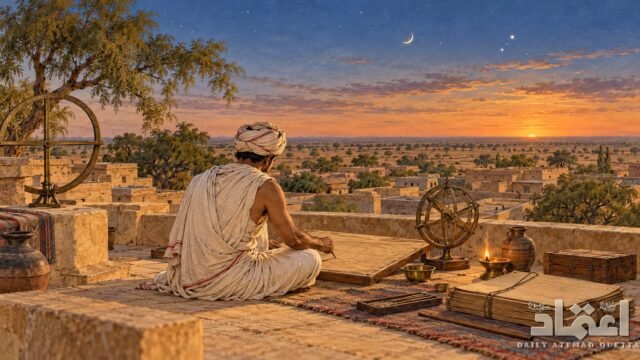 Zero and the decimal system: how humanity learnt to count nothing
 Al-Biruni's measurements: from the hill at Nandana to the weight of gold
 Al-Jazari's machines: water, wheels and masterly craftsmanship
 Al-Razi and how he told smallpox from measles
 Al-Zahrawi, the Cordoba surgeon who taught surgery through pictures of instruments
 Algebra: al-Khwarizmi and the science of restoration and balancing
 Archimedes: the law of the lever and the principle of buoyancy
 Astrolabe: the sky that fitted in the hand