
15 October 1896: Quetta Municipality’s first day
On 15 October 1896 the Quetta Municipal Law came into force, placing the city's administration, sanitation, water and octroi under a municipal committee.
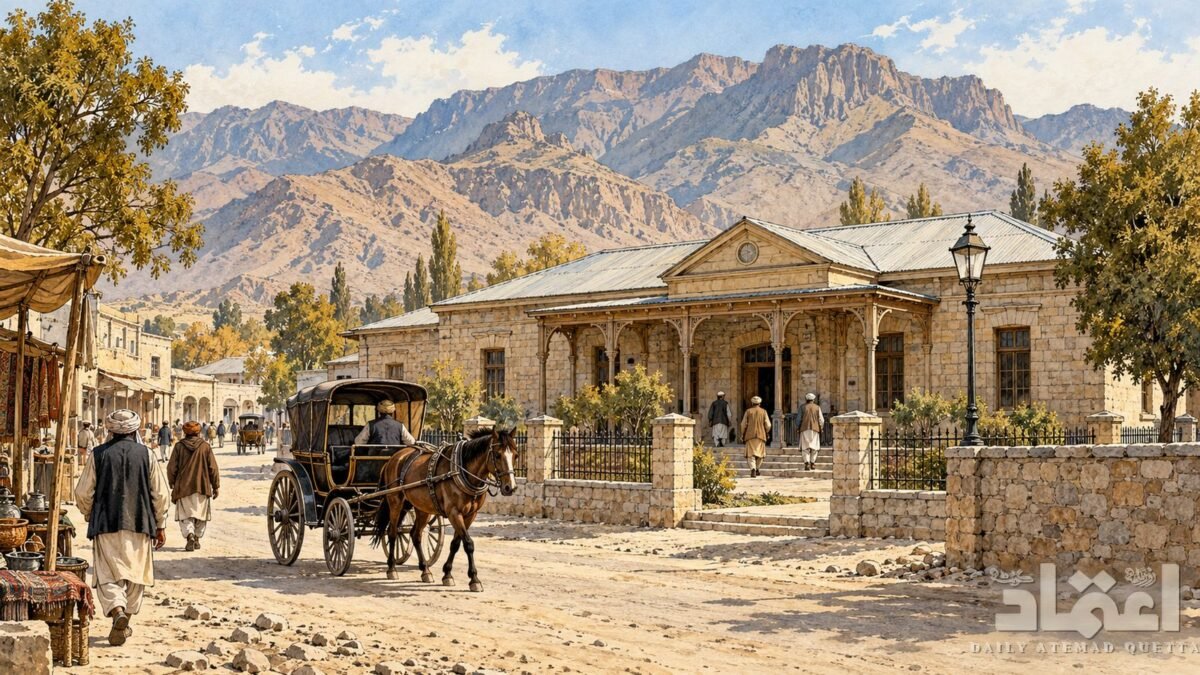
Pages from history: This account describes a day before the launch of Roznama Atemad (October 1970). It has been compiled from available historical sources.
Thursday, 15 October 1896. It seemed an ordinary day in Quetta’s cantonment and civil bazaar, but on paper the status of the city had changed. From that morning the "Quetta Municipal Law, 1896" came into force, and the administration, sanitation, water supply and octroi of the city passed to a regular municipal committee. According to the Imperial Gazetteer, Quetta was the only town in the whole of Baluchistan where a regular municipality was set up. The other towns had only "bazaar funds", run by government officers.
Quetta before the municipality
The present British occupation began in 1876. Under the Khan of Kalat, octroi and transit dues were levied on goods coming to Quetta. According to the Quetta-Pishin Gazetteer, the British kept the octroi, soon abolished the transit dues, and in 1878 imposed a conservancy cess. The accounts of these sums were kept first by the assistant to the Agent to the Governor-General and then by the Treasury Officer of Quetta. In important matters the Political Agent consulted the "Quetta Panchayat", which included leading members of the Indian trading communities.
The government bought the land of the town between 1878 and 1883 and gave it to the old residents who had been moved out of the fort. In 1888 the Government of India allowed barren government land within the municipal limits to be given to this body, and in 1894 a salaried secretary was appointed. Thus the name "municipality" was in use before the law, but it had no legal basis.
The law and its enforcement
According to the administration report of the Baluchistan Agency for 1896-97, the law was made by the Governor-General in Council and published in a Foreign Department notification of 4 September 1896. The date of enforcement was to be fixed by the Agent to the Governor-General. In early October the acting Agent to the Governor-General issued Notification No. 6992, naming 15 October 1896 as the day the law would come into force. The Imperial Gazetteer (1908) also gives this date.
Under the law, the committee was to have the Political Agent of Quetta and Pishin and at least six members, nominated by the Agent to the Governor-General. No member could serve for more than three years. The Political Agent was chairman by virtue of his office and prepared the budget and the annual report. Any expenditure outside the budget required the Commissioner’s sanction. The committee had to meet at least once a month, and the quorum was one-third of the members. There was no element of election: according to a report presented to the Constituent Assembly in 1951, the committee consisted only of nominated members.
One day, four dates
The official sources do not agree on the day of enforcement. The notification and the Imperial Gazetteer give 15 October. The 1896-97 administration report gives 16 October. The Quetta-Pishin Gazetteer (1907) gives 1 October, adding that the first municipal committee was appointed on 17 October. That committee had the Political Agent as chairman, five members by virtue of office and four nominated members. We have adopted the date of the notification because it is legally decisive. As for 1897, it was not the founding year but the end of the first financial year: the year closed on 31 March 1897.
The first year
According to the administration report, the committee held nine meetings in 1896-97, two special and seven ordinary. In its first year it framed three sets of rules: regulations on smallpox vaccination, rules for the conduct of meetings, and rules for slaughterhouses. The total income of the municipal fund was Rs172,987 and the expenditure Rs198,259. The main source of income was octroi. The municipal share was paid towards building a reservoir for the Quetta waterworks, and an instalment of the government loans for drainage and waterworks was repaid.
In the same year the new committee faced its first major test. On 30 December 1896 the Agent to the Governor-General learned that plague had become an epidemic in Karachi. Medical inspection began for passengers arriving at the stations of Sibi, Bostan, Quetta and Chaman, and a camp was later set up at Sibi where suspected passengers could be detained for ten days. In Quetta the municipal committee and the Political Agent received special powers under the epidemic diseases law, and a special sanitary committee was formed of members of the municipal and cantonment committees and notable citizens of the city. According to the report, there was no case of plague in Quetta by the end of the year. A notification of 7 April 1897 empowered the municipal committee to meet the costs of plague prevention.
Baluchistan, 1896
- Leadership: According to the Imperial Gazetteer, General Sir James Browne became Agent to the Governor-General after Sir Robert Sandeman. He died in 1896, and Hugh Barnes took over the post in the same year.
- Judiciary: In 1896 the civil and criminal justice laws were re-enacted and the post of Judicial Commissioner, the high court of Baluchistan, was created.
- Frontiers: The Baluch-Afghan Boundary Commission demarcated the northern frontier from 1894 to 1896, and in 1896 the Anglo-Persian Commission fixed the line from Kuhak to Koh-i-Malik Siah.
- Hemp: From July 1896 the cultivation of hemp was completely banned in British Baluchistan.
- Quetta: In the 1891 census the population of the town and cantonment was 18,802.
What happened next
- 1897: According to the Quetta-Pishin Gazetteer, the Mushkaf-Bolan railway through the Bolan Pass was completed and opened to traffic.
- 1901: According to the Imperial Gazetteer, the population of the town and cantonment rose to 24,584. In the four years to 1901 municipal income averaged Rs1.7 lakh, reaching Rs2.2 lakh in 1903-4. Half of the net octroi income went to the cantonment committee.
- 17 October 1905: The limits of the municipality were formally fixed for the first time by Notification No. 4910 of the Agent to the Governor-General. That year the committee had five members by virtue of office and ten nominated members.
- 31 May 1935: An earthquake completely destroyed Quetta’s civil lines (Dawn).
- 1946: The 1896 law was replaced by the "Quetta Municipal Law, 1946". According to the Constituent Assembly’s 1951 report, ten members were now elected from ten wards on a joint electoral roll and nine were nominated, and the Political Agent of Quetta-Pishin remained chairman.
Do you have a document, map, receipt or photograph from the early period of Quetta Municipality? Please send it to us. We will add it to this page with your name.
Sources
- Government of India, British Enactments in Force in Native States, Northern India (Calcutta: Superintendent of Government Printing, India; DLI copy catalogued 1899), chapter II, "The Baluchistan Agency Territories": text of the Quetta Municipal Law, 1896 (sections 3–14: committee of the Political Agent and not fewer than six appointed members, term up to three years, Political Agent ex officio chairman and budget-maker, Commissioner's sanction, monthly meetings, one-third quorum), and p. 426, Notification No. 6992 (October 1896) appointing 15 October 1896 as the day of commencement, citing Gazette of India, 1896, Pt II, p. 1061. Opened (full OCR). https://archive.org/details/in.ernet.dli.2015.81384
- Government of India, British Enactments in Force in Indian States, vol. I, 4th ed. (1930): footnote to the Quetta Municipal Law, "The 15th October, 1896, was so appointed by Notification No. 6992". Opened (full OCR). https://archive.org/details/in.ernet.dli.2015.100329
- R. Hughes-Buller (comp.), Imperial Gazetteer of India, Provincial Series: Baluchistan (Calcutta: Superintendent of Government Printing, 1908), p. 74 (law in force 15 October 1896; Quetta the only formally constituted municipality; octroi before 1876, conservancy cess 1878; income figures; half of net octroi to the cantonment), p. 126 (municipality formally constituted October 1896), pp. 129–130 (Quetta town; population 18,802 in 1891 and 24,584 in 1901; present municipal system dates from 1896), and the 1896 items in "Baluchistan, 1896". Opened (full OCR). https://archive.org/details/ImperialGazetteerOfIndiaBaluchistan
- R. Hughes-Buller, assisted by Diwan Jamiat Rai, Baluchistan District Gazetteer Series, vol. V: Quetta-Pishin District (Ajmer: Scottish Mission Industries, 1907; preface dated Quetta, September 1906), pp. 335–337 (octroi and transit dues under Kalat; conservancy cess 1878; Quetta Panchayat; land bought 1878–1883; 1888 order on waste land; paid secretary 1894; law in force 1 October 1896; first committee appointed 17 October 1896 with five ex officio and four nominated members; 1905 composition; limits notified by Notification No. 4910 of 17 October 1905), and the opening of the Mushkaf-Bolan line in 1897. Opened (full OCR). https://archive.org/details/in.ernet.dli.2015.46886
- Government of India, Foreign Department, Report on the Administration of the Baluchistan Agency for 1896-97 (bound with the reports for 1894-95 and 1895-96, Selections from the Records of the Government of India), para 24 and para 57 (law published by notification of 4 September 1896, in force 16 October 1896; nine meetings; rules framed; receipts and expenditure of the Quetta Municipal Fund), chapter XV "Plague" (paras 169–172), and Notification No. 1667 of 7 April 1897. Opened (full OCR). https://archive.org/details/india.history.resource.109824
- Constituent Assembly of Pakistan Debates, vol. X, no. 1 (Karachi: Manager of Publications, 1951), report on Baluchistan: Quetta Municipal Committee came into existence in 1896 with nominated members only; superseded by the Quetta Municipal Law, 1946 (10 elected, 9 nominated; Political Agent ex officio chairman). Opened (full OCR). https://archive.org/details/CAPD_X_1
- Dawn, "The great Quetta tragedy" (Lahori's Notebook), 25 October 2005 (civil lines completely destroyed in the 1935 earthquake). Opened. https://www.dawn.com/news/1068419/dawn-features-october-25-2005
- Martin Axmann, Back to the Future: The Khanate of Kalat and the Genesis of Baloch Nationalism, 1915–1955 (Karachi: Oxford University Press, 2008): committee "came into existence on 17 October 1896". https://archive.org/details/backtofuturekhan0000axma
 More from Pages of history
More → 31 May 1935: The Quetta earthquake
 14 February 1948: Quaid-i-Azam at the Sibi Durbar
 14 June 1948: Quaid-e-Azam addresses Staff College in Quetta
 11 September 1948: Quaid-i-Azam's last journey from Balochistan
 November 1952: gas discovered at Sui
 8 September 1958: Gwadar comes under Pakistan
 28 May 1998: Pakistan conducts nuclear tests at Ras Koh in Chagai
 Gwadar deep-sea port foundation stone laid on 22 March 2002