
Khuzdar, heart of Jhalawan: from ancient Qusdar to a new division
Khuzdar, the first major city on the Quetta-Karachi highway below the Kalat hills, has long been the centre of Jhalawan and is now a divisional headquarters.
Introduction and location
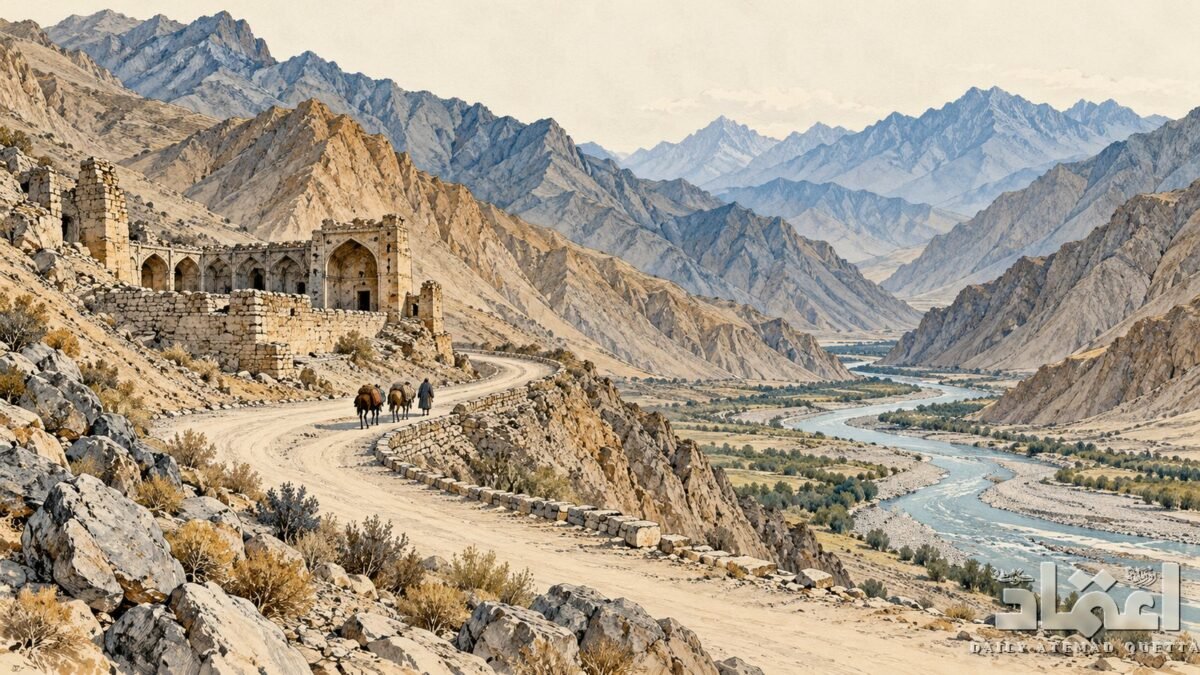
On the national highway from Quetta to Karachi, the first major city after descending from the Kalat mountain ranges is Khuzdar. For centuries it has been the centre of the region known in history as Jhalawan. This was the southern part of the state of Kalat, bordering Sarawan to the north, Kachhi and Sindh to the east, Lasbela to the south, and Kharan and Makran to the west.
Khuzdar is among the districts of Balochistan whose administrative position changed in 2026. Under a notification issued by the provincial Revenue Department on 8 July 2026, reported by Dawn and other newspapers, the province was divided into 11 divisions and 41 districts. The old Kalat Division was abolished and replaced by two new divisions: Khuzdar Division, comprising Khuzdar, Kalat, Surab and the new Wadh district, and Lasbela Division. According to newspaper reports, the new Wadh district was carved out of Khuzdar and includes the sub-divisions of Wadh, Oranch and Nal. The sub-division of Zehri was added to Surab district, which was previously called Shaheed Sikandarabad. Khuzdar is thus now a divisional headquarters, but its own area and population are smaller than before.
History
The name Khuzdar appears in the works of Arab and Persian geographers as “Qusdar” or “Quzdar”. According to the Encyclopaedia Iranica article “Turan”, the area was known as Turan in the early Islamic period, and sources from after the late 10th century use only the name Qusdar for the region. According to the same article, the ruler of Qusdar was made a tributary in 966-967, and Ghaznavid armies later also came this way. Qusdar is mentioned among the cities of Turan in the books of the 10th-century geographers Istakhri and Ibn Hawqal, which shows that a thousand years ago the settlement was a well-known town of the region.
In later centuries Khuzdar became the headquarters of the Jhalawan region of the state of Kalat. The Jhalawan volume of the Baluchistan District Gazetteer Series, published in 1907 in the British period, preserves a detailed account of the region’s tribes, routes, climate and relationship with the Khans of Kalat. It is from this volume that we learn of the boundaries of Jhalawan in that period and the central position of Khuzdar. The state of Kalat became part of Pakistan after 1947, and the Kalat region was later divided into districts, including Khuzdar. The year in which Khuzdar was made a separate district will be given here after confirmation from an official source.
Khuzdar’s history begins long before the Islamic period. The mound of Sohr Damb near Nal came to the world’s notice through the excavation of archaeologist Harold Hargreaves in 1925, and the painted pottery found there gave experts the name “Nal culture”. Between 2001 and 2004, a joint German-Pakistani mission led by Ute Franke-Vogt excavated the site again. According to radiocarbon dating, the settlement was inhabited in four phases between about 3800 and 2000 BC. The land of Khuzdar is thus home to an important culture that predates the Indus Valley Civilisation.
People and languages
According to the 2023 census, Khuzdar tehsil, the district headquarters, had a population of 359,358, of whom 218,112 lived in urban areas and 141,246 in rural areas. The same census recorded the population of Zehri tehsil as 150,928, Nal as 103,631, Arnji as 50,533, Oranch as 41,811, Saruna as 36,380 and Karkh as 35,990. The 2017 census recorded the population of the entire district as 798,896. The 2023 district total and area will be added after confirmation from the Pakistan Bureau of Statistics tables, since the district’s boundaries have changed after the July 2026 division.
By mother tongue, the district is among the Brahui-majority districts of Balochistan. According to Table 11 of the 2023 census, of the 359,358 people in Khuzdar tehsil, 342,974 gave Brahui as their mother tongue, while 6,044 spoke Pashto and 5,652 spoke Balochi. In Zehri tehsil, 150,317 people speak Brahui. In contrast, Balochi predominates in Nal tehsil, where 87,685 people have Balochi as their mother tongue and 15,560 have Brahui. In Karkh tehsil, alongside Brahui (24,489), there are also Sindhi (7,070) and Balochi (4,255) speakers, a result of its proximity to the Sindh border.
Economy
Education is a prominent pillar of Khuzdar’s economy. The Balochistan University of Engineering and Technology, Khuzdar, is the province’s first engineering institution. According to the university’s prospectus, the federal government began a project for an engineering college in Khuzdar in 1973-74, ECNEC approved it in 1977, and the first classes began in 1987-88 with 90 students in civil, mechanical and electrical engineering. In 1994 it was given university status under the Balochistan University of Engineering and Technology Act.
The city’s other great importance is its location. Lying between Quetta and Karachi on the national highway, Khuzdar is the centre of Jhalawan’s trade and traffic. In recent years tourism has also emerged as a new sector. Official figures on minerals have not been included in this draft because the relevant institution’s source could not be accessed.
Places of interest
Mola Chotok: In the Mola area of the district is a narrow valley hidden in the mountains, with springs, waterfalls and pools of green water. According to a travelogue published in Dawn in 2017, pictures of green water amid scorching rocks spread across the country through social media and the number of tourists suddenly rose. However, a lack of accommodation and facilities, and a problem of litter, also came to light. The site can be reached only by four-wheel-drive vehicle.
Nal and Sohr Damb: This ancient mound near Nal holds an important place among the prehistoric remains of South Asia. Its painted pottery is held in museums around the world, and its layers go back to about 4000 BC.
Zehri: The Zehri area lies north-east of Khuzdar. According to the 2023 census, it was the most populous tehsil in the district after Khuzdar tehsil. Under the 2026 notification, it has now been included in Surab district.
Sources
- Pakistan Bureau of Statistics, 7th Population and Housing Census 2023, Balochistan, Table 1: Area, Population by Sex, Sex Ratio, Population Density, Urban Population, Household Size and Annual Growth Rate (district and tehsil tables), Islamabad, 2023. https://www.pbs.gov.pk/sites/default/files/population/2023/tables/table_1_balochistan_province.pdf
- Pakistan Bureau of Statistics, 7th Population and Housing Census 2023, Balochistan, Table 11: Population by Mother Tongue, Sex and Rural/Urban (districts), Islamabad, 2023. https://www.pbs.gov.pk/sites/default/files/population/2023/tables/table_11_balochistan_districts.pdf
- Pakistan Bureau of Statistics, District Census Report 2017: Khuzdar (Population Census 2017 results), Islamabad, 2017. https://www.pbs.gov.pk/sites/default/files/population/2017/results/10720.pdf
- Saleem Shahid, "Balochistan undergoes major restructuring", Dawn, July 2026. https://www.dawn.com/news/2014773/balochistan-undergoes-major-restructuring · Also: "Quetta split into two districts as Balochistan undergoes administrative restructuring", Dawn. https://www.dawn.com/news/2014627 · ProPakistani, "Balochistan Govt Notifies New Divisions and Districts", 12 July 2026. https://propakistani.pk/2026/07/12/balochistan-govt-notifies-new-divisions-and-districts/
- Government of India, Baluchistan District Gazetteer Series, Vol. VI-B: Jhalawan, Bombay Education Society's Press, Bombay, 1907. Scan (Sindh Irrigation Department library): https://irrigation.sindh.gov.pk/files/Books//136.pdf · Series volume on archive.org: https://archive.org/details/bub_gb_jb61AAAAIAAJ · Catalogue: https://catalog.hathitrust.org/Record/012154569
- Encyclopaedia Iranica, "Ṭurān", online edition. https://www.iranicaonline.org/articles/turan/
- H. Hargreaves, Excavations in Baluchistan 1925: Sampur Mound, Mastung and Sohr Damb, Nal, Memoirs of the Archaeological Survey of India No. 35, Calcutta, 1929. https://books.google.com/books/about/Excavations_in_Baluchistan_Sampur_Mound.html?id=cnjjAAAAMAAJ
- U. Franke-Vogt, "Sohr Damb/Nal, Baluchistan, Pakistan: Results of the excavations 2001, 2002 and 2004", in South Asian Archaeology 2003, Aachen, 2005. https://www.researchgate.net/profile/Ute-Franke/publication/292443409_Sohr_DambNal_Baluchistan_Pakistan_Results_of_the_excavations_2001_2002_and_2004/links/6422bd9392cfd54f8433f2bb/Sohr-Damb-Nal-Baluchistan-Pakistan-Results-of-the-excavations-2001-2002-and-2004.pdf · J. Görsdorf and U. Franke-Vogt, "Implications of Radiocarbon Dates from Sohr Damb/Nal, Balochistan", Radiocarbon 49(2), 2007. https://www.researchgate.net/publication/277064515_Implication_of_Radiocarbon_Dates_from_Sohr_DambNal_Balochistan
- Balochistan University of Engineering and Technology Khuzdar, Prospectus 2021–22, Khuzdar. https://www.buetk.edu.pk/wp-content/uploads/2024/08/Prospectus-2021-22.pdf
- Danial Shah, "How I discovered the hidden springs of Khuzdar in Balochistan", Dawn, 2017. https://www.dawn.com/news/1315708
 More from Districts
More → Killa Abdullah district: land of karezes and vineyards at the foot of Khwaja Amran
 Killa Saifullah district: the upper Zhob river valley
 Kohlu district: the Kahan and Kohlu valleys
 Lasbela district: from the Jam's princely state to Lasbela Division
 Loralai district: almond orchards of Bori valley and seat of a division
 Mastung district: the heart of Sarawan and a valley of apples
 Musakhel district: Suleiman Range pastures and the markhor's habitat
 Nasirabad district: a canal-fed plain on the eastern edge of Kachhi