
Alexander’s return march through Makran, 325 BC: what the Greek sources record
In 325 BC Alexander's army crossed Lasbela and Makran on its way back from India. Greek writers describe the march as a disaster.
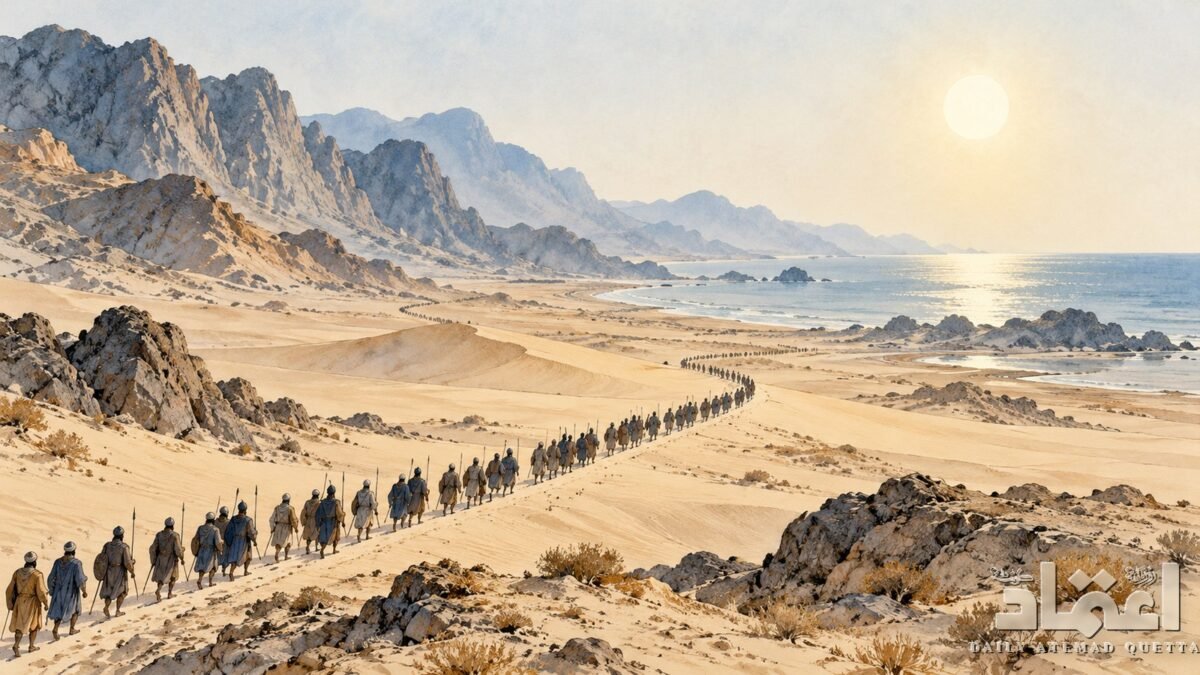
West of the plain of Lasbela lie the Hingol mountains, and beyond them the long, dry and empty coast of Makran. Some 2,300 years ago this land became a path of death for the most famous army in the world. In 325 BC Alexander the Great, King of Macedonia, passed this way on his return from the campaign in India. Greek and Roman writers call the region Gedrosia. It covered, roughly, today’s southern Balochistan and Iranian Makran.
From the Indus to Lasbela
Alexander’s army had refused to go further at the River Beas, so the king returned towards the sea along the Indus. There he split his force in two. A large fleet, under his old and loyal companion Nearchus, was to sail to the Persian Gulf. The rest of the army was to march west over land with the king.
The land route crossed the River Arabius into the territory of the tribe the Greeks call the Oreitai. Arrian, the most reliable ancient historian of Alexander’s campaigns, writes that these people lived in the area, had long been independent, and that their largest village was Rambakia. Alexander liked the place so much that he thought a city built there would grow large and prosperous. He entrusted the task to his close companion Hephaestion.
Where was Rambakia?
The question has never been settled. The British survey officer Colonel Holdich took Rambakia to be the centre of the Oreitai and placed it in the territory of the former state of Lasbela, probably at Khair Kot, north-west of Liari. Salman Rashid also takes Rambakia to be Lasbela. On the other side, Chinnock, Arrian’s English translator, wrote in a note in 1884 that it was near “Haur”. The identity of the river Arrian calls the Arabius, which Alexander crossed to enter the Oreitai country, is also disputed. The Encyclopaedia Iranica names it as the Hab, west of Karachi. Chinnock and Holdich take it to be the Purali of Lasbela. Placing Rambakia in Lasbela is therefore a scholarly opinion, not an established fact.
The Jhao pass or another?
According to Arrian, the Oreitai and the people of Gedrosia together held a narrow pass. Most fled when they heard Alexander was coming, and their chiefs surrendered. Alexander appointed Apollophanes governor of the region. He left his royal bodyguard Leonnatus with some troops to wait for the fleet and to settle the new town. After Alexander left, the Oreitai rebelled and Leonnatus defeated them.
Which way Alexander went next is also disputed. Travel writer Salman Rashid believes he went inland along the River Purali and that the narrow pass is today’s Jhao. According to Eggermont, the army went along the coast to the mouth of the Hingol and turned north from there towards the Kolwa plain. Salman Rashid says the Hingol valley cannot be crossed by a heavy army.
In the desert
On entering Gedrosia, Arrian, citing Aristobulus, mentions large myrrh trees and fragrant nard roots, crushed by the army’s feet, which filled the whole land with their scent. Then the suffering began. Alexander wanted to stay near the coast to dig wells and collect grain for the fleet. On the shore, however, he found only fishermen living in huts made of shells. The grain he sent to the coast under seal was eaten by its own guards and given to the starving. The king understood their desperation and forgave them.
Arrian says that writers on Alexander describe the hardships of this march as worse than those of all his campaigns in Asia. Heat and thirst destroyed much of the army. Horses and mules died in the deep, soft sand. When the animals were gone, soldiers slaughtered them in their hunger and said they had died of thirst. The sick and exhausted were left behind. One night monsoon rain fell in the mountains and a stream near the camp suddenly became a flood. It swept away most of the women and children travelling with the army. The Greek geographer Strabo writes that many soldiers, in their thirst, fell into wells in full armour and drowned while drinking.
Arrian tells the most famous episode as follows, although he admits that some writers place it elsewhere. Some soldiers found a small spring and brought water in a helmet to the king. Alexander thanked them and poured the water on the ground in front of everyone. This put new life into the whole army. Once the wind blew away the tracks on the sand and the guides lost their way. Alexander reached the sea with only five men and dug the shore to find fresh water.
According to Arrian, the journey from the Oreitai country to Pura, the capital of Gedrosia, took sixty days. The site of Pura is also uncertain. According to the Encyclopaedia Iranica, it was probably in the Bampur oasis of Iranian Balochistan. On reaching it, Alexander removed Apollophanes for disobeying orders. He later made Sibyrtius governor of both Arachosia (the Kandahar region) and Gedrosia.
Why this route?
Arrian, citing Nearchus, writes that Alexander was not unaware of the difficulties of the route. He had been told that only Queen Semiramis and the Persian king Cyrus had brought an army through this desert, and that both had suffered heavy losses. Alexander wanted to surpass them. Nearchus also says he wished to stay near the coast to supply the fleet, and Strabo writes the same.
How great were the losses? Plutarch claims that Alexander had 120,000 foot soldiers and 15,000 horsemen in India and that not even a quarter of them came back. He puts this down to disease, poor food, heat and above all hunger. Arrian gives no figure, and we have no means of verifying ancient numbers.
Nearchus’s voyage
Nearchus’s fleet left the Indus in autumn, after the summer monsoon winds had died down. Arrian gives the date as the twentieth day of the Athenian month of Boedromion, which scholars place in September or October. The fleet fought contrary winds as it sailed along the Makran coast. It passed the bay of Sonmiani and the coast of Kokala. Near Kokala, Leonnatus had defeated the Oreitai in a major battle, and the fleet took ten days’ rations from grain collected on Alexander’s orders. In Arrian’s Indica, which is based on Nearchus’s own book, a river called the Tomeros appears. Holdich identifies it as the mouth of the Hingol. Further on, the coast was home to the people the Greeks called “Fish-eaters”. The people of Gedrosia lived behind them, inland, in a poor and sandy land. The fleet passed the Gwadar area, reached Carmania and anchored in the region of Harmozeia. From there Nearchus went inland and met Alexander, who had feared his fleet was lost. Nearchus wrote a book about his voyage. It has been lost, but Arrian and Strabo copied much from it.
What remains in Balochistan today?
The truth is that no trace of Alexander’s passage on Balochistan’s soil has been identified on which experts agree. The archaeologist Sir Aurel Stein surveyed the Makran coast, Kolwa and Jhalawan and published “An Archaeological Tour in Gedrosia” in 1931. In early 1943, a few months before his death in Kabul, he went to Lasbela specifically to trace Alexander’s route. He travelled from Ormara through the Hingol valley to Jhao. His paper “On Alexander’s Route into Gedrosia” was published the same year. Even so, Rambakia, Alexander’s Alexandria and the army’s route remain open questions.
What survives are names: Hingol, Sonmiani, Gwadar and Lasbela, which are still linked to the accounts of Nearchus and Arrian. The detailed written account of this land that has reached us from Greek writers is an account of the destruction of an army.
Next Sunday: the Mauryas, the Indo-Greeks and the Kushans: who ruled the edges of Balochistan in the centuries after Alexander?
Sources
- Arrian, The Anabasis of Alexander, translated by E. J. Chinnock (London: Hodder and Stoughton, 1884). Scan: https://archive.org/details/cu31924026460752 . Book III ch. 6 (Nearchus banished by Philip as an adherent of Alexander), p. 151; Book V ch. 24–29 (the army refuses to cross the Hyphasis, "now called the Beas"), pp. 306–315; Book VI ch. 21 (the Arabius, note "now called the Purally", p. 350; the Oritians "long independent"; Rambacia, note "probably at or near Haur"), pp. 349–351, https://archive.org/details/cu31924026460752/page/n371 ; ch. 22 (the pass, Apollophanes, Leonnatus; myrrh and nard after Aristobulus), pp. 351–353; ch. 23 (Thoas, the fishermen's huts, the sealed grain), pp. 353–354; ch. 24 (Pura, sixty days from Ora, Semiramis and Cyrus, Nearchus on the motive), pp. 355–356; ch. 25 (beasts slaughtered, stragglers, the flash flood), pp. 356–358; ch. 26 (the helmet of water, the lost guides, five men reach the sea), pp. 358–360; ch. 27 (Apollophanes deposed, Thoas, Sibyrtius over Arachosia and Gedrosia), p. 360; Book VII ch. 5 (Leonnatus crowned for his victory over the Oritians), p. 377. Same translation on Wikisource: https://en.wikisource.org/wiki/The_Anabasis_of_Alexander/Book_VI/Chapter_XXI (and Chapters XXII–XXVII).
- Arrian, Indica (Book VIII), in Arrian, vol. II, translated by E. Iliff Robson, Loeb Classical Library (London: Heinemann, 1933; reprint 1949). Scan: https://archive.org/details/in.ernet.dli.2015.107422 . Ch. 21.1 (departure "on the twentieth day of the month Boedromion"; Robson's note: "probably October 326, though Droysen fixes the date as September 325"), p. 367, https://archive.org/details/in.ernet.dli.2015.107422/page/n377 ; ch. 21–22 (Alexander's Haven, Morontobara, the Arabis), pp. 369–373; ch. 23 (Cocala; Leonnatus defeats the Oreitans; ten days' rations from corn gathered by Alexander's orders), pp. 375–377; ch. 24 (the Tomerus), p. 377; ch. 26 (Gadrosians inland, Fish-eaters on the coast), pp. 381–383; ch. 32.1 (the Gadrosians' "poor and sandy territory"), p. 401; ch. 33–35 (Harmozeia on the Anamis; Nearchus meets Alexander inland; Alexander's fear for the fleet), pp. 403–411.
- Strabo, The Geography of Strabo, vol. VII, translated by H. L. Jones, Loeb Classical Library (1930; reprint 1954), Book 15.2.3–7 (myrrh and nard; Alexander keeps near the sea to equip the seaboard for the fleet; Nearchus sails "in the autumn" and the barbarians "took courage when the king departed"; soldiers plunging into the wells "armour and all"; the torrent; seven days along the shore; sixty days to the Gedrosian capital), pp. 133–139, https://archive.org/details/in.ernet.dli.2015.57231/page/n147 (p. 137).
- Plutarch, Life of Alexander 66, in Plutarch's Lives, vol. VII, translated by Bernadotte Perrin, Loeb Classical Library (1919), p. 411 ("not even the fourth part of his fighting force was brought back from India"; 120,000 foot and 15,000 horse; diseases, food, heat and famine; sixty days). https://archive.org/details/liveswithenglish07plut/page/n426
- Willem J. Vogelsang, "Gedrosia", Encyclopaedia Iranica, vol. X, fasc. 4, pp. 390–391, published 15 December 2000 (extent of the province; the Arabius "the modern Hab, west of Karachi"; sixty days; Pura "possibly in the Bampūr oasis"; Apollophanes, Thoas, Sibyrtius; Nearchos's account partly surviving in the Indica). https://www.iranicaonline.org/articles/gedrosia-
- Colonel Sir Thomas Holdich, The Gates of India, Being an Historical Narrative (London: Macmillan, 1910): the Purali as the Arabius, p. 149; Rambakia possibly at Khair Kot, north-west of Liari, in the Bela district, pp. 150–151; contrary winds to the Hingol, p. 154; islands between Cape Monze and Sonmiani, Morontobara = Sirondha lake, p. 155; the Tomeros = the Hingol estuary, p. 157; Barna/Badara = Gwadur, p. 159. https://archive.org/details/gatesofindiabein00hold/page/n172
- Salman Rashid, "Non-fiction: The speculative Alexander" (review of P. H. L. Eggermont, Alexander's Campaigns in Sind and Baluchistan and the Siege of the Brahmin Town of Harmatelia, reprint Endowment Fund Trust for Preservation of the Heritage of Sindh, Karachi), Dawn, Books & Authors, 4 September 2022 (Rambakia = Lasbela; the "narrow pass" = the Jhao; the march along the Porali; Eggermont's coastal route via Sonmiani Bay and the Hingol estuary north into the Kolwa plain; the Hingol valley unsuitable for heavy troops; Arachosia = the Kandahar area). https://www.dawn.com/news/1708361
- Sir Aurel Stein, An Archaeological Tour in Gedrosia, Memoirs of the Archaeological Survey of India no. 43 (Calcutta: Government of India, 1931): ch. V "Remains on Makran coast", p. 71; ch. VII "Ruined sites of Kolwa", p. 104; ch. X "Along the central valley of Jhalawan and Sarawan", p. 170. https://archive.org/details/in.ernet.dli.2015.31867
- Sir Aurel Stein, "On Alexander's Route into Gedrosia: An Archaeological Tour in Las Bela", The Geographical Journal 102 (1943), pp. 193 ff., DOI 10.2307/1789131. Stein's death at Kabul on 26 October 1943: The Geographical Journal 102, no. 3 (1943), p. 143, https://archive.org/details/sim_geographical-journal_1943-09_102_3/page/n64
- Jeannette Mirsky, Sir Aurel Stein: Archaeological Explorer (Chicago: University of Chicago Press, 1977), pp. 540–541 (the 1943 Las Bela tour from the end of January: Ormara, up the Hingol valley to Jhau, "tracing the exact route followed by Alexander"), p. 545 (the Las Bela article accepted by the Geographical Journal). https://archive.org/details/mirsky-1977-sir-aurel-stein-archaeological-explorer/page/n566
 More from Balochistan: a journey through history
More → Mauryas, Greco-Bactrians and Kushans: what is known of Balochistan after Alexander
 Sasanian era: Turan and Makran in the long silence of Balochistan's history
 The battle with Rasil and the coming of Islam to Makran
 The route of Muhammad bin Qasim through Makran (711)
 Qiqan, Qusdar and Turan in the eyes of Arab geographers
 Ghaznavid and Ghurid eras: Quzdar and Kech Makran under Ghazna and Ghor
 Arrival of the Baloch tribes: from Kerman to Makran
 Brahui: one language, one puzzle